

I own the two major payment card networks as a single mental position.
Thesis
If history is any indication, more payments will flow through Visa and Mastercard’s networks, and the two companies will continue to generate more value from them.
Everyone is winning
Despite their (in)famously high margins, Visa and Mastercard leave most of the potential fees on the table and create a much bigger value to the network participants than they extract.
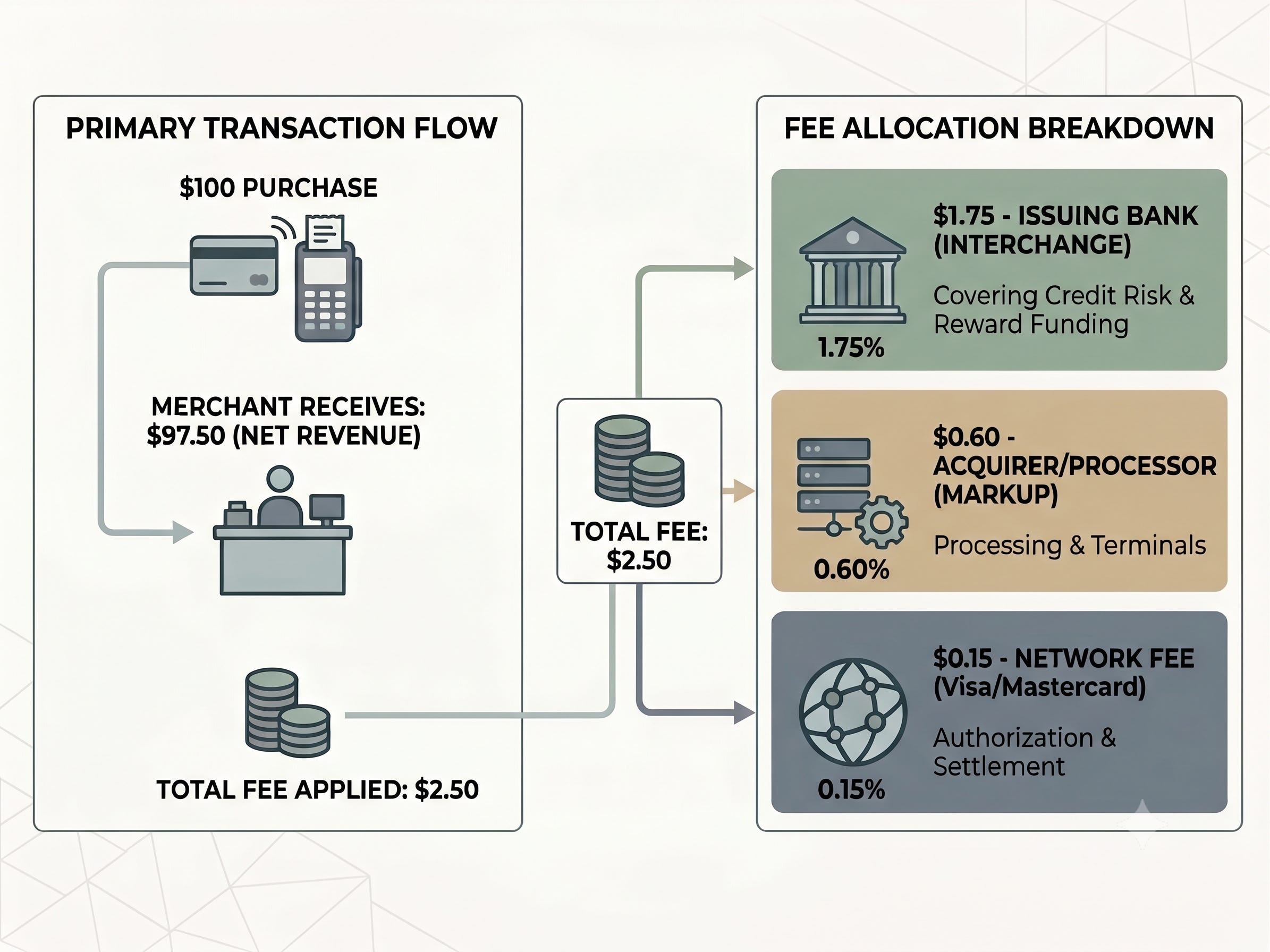
Consumers get to pay with convenience, financing and protection.
Merchants get to serve more customers who tend spend more.
Banks get to earn highly profitable commissions on payments by servicing familiar clients with whom they have a direct relation.
Moat is expanding
Visa and Mastercard neither handle money for merchants nor lend to consumers. They run information networks between banks with the goal of keeping an authoritative record of payment flow. In a world with thousands of bank, millions of merchants and billions of consumers, these two companies are the ultimate arbiters of which bank should add/remove balance to/from which client’s bank account.
The strength and pricing power of these two networks against alternatives depend on two factors:
Size in transactions, participants and volume
Exclusivity of handling “difficult” connections, whether due to the source of funding (credit-funded payments) or the location of endpoints (cross-border payments)
Network is growing
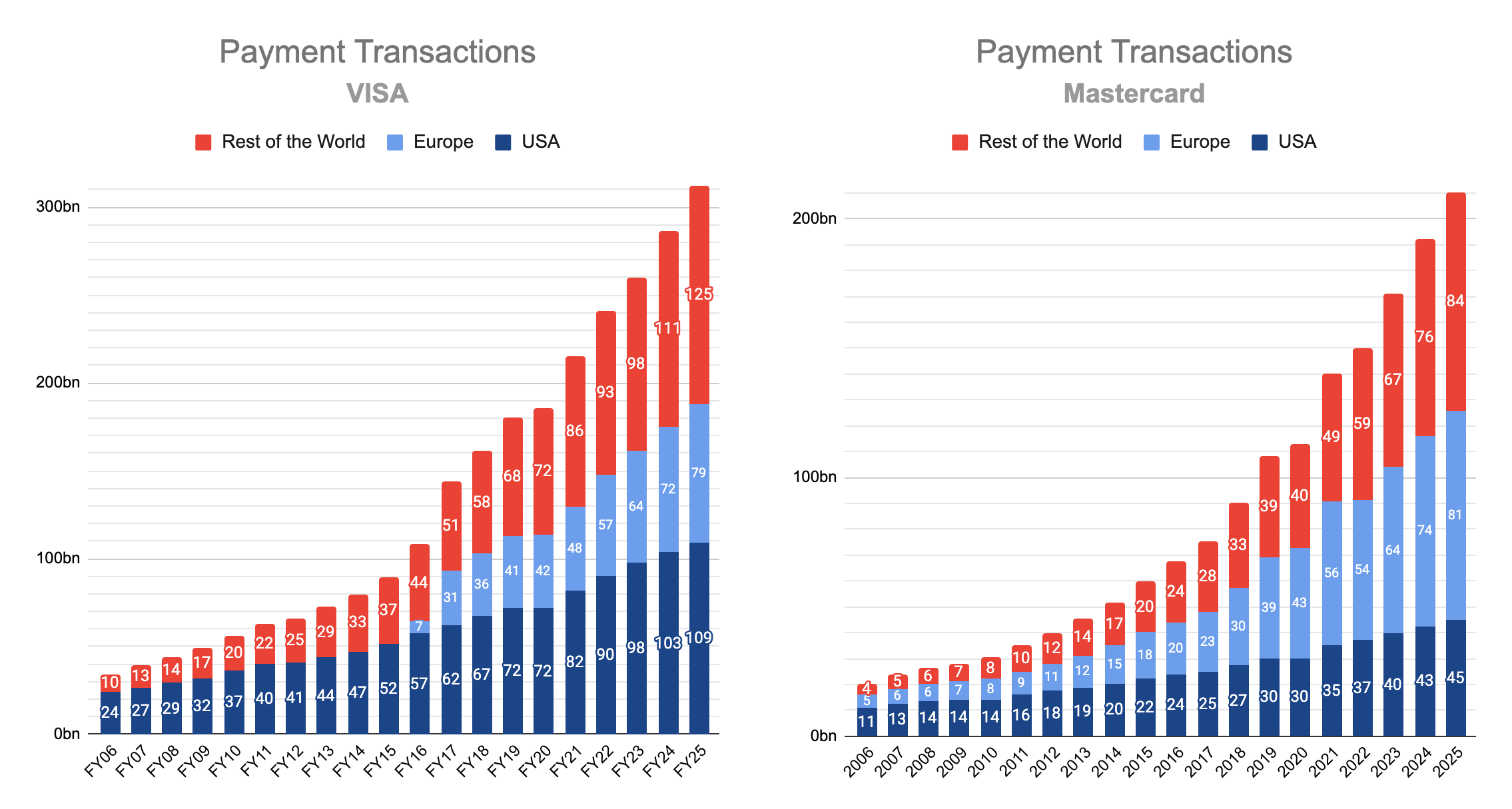
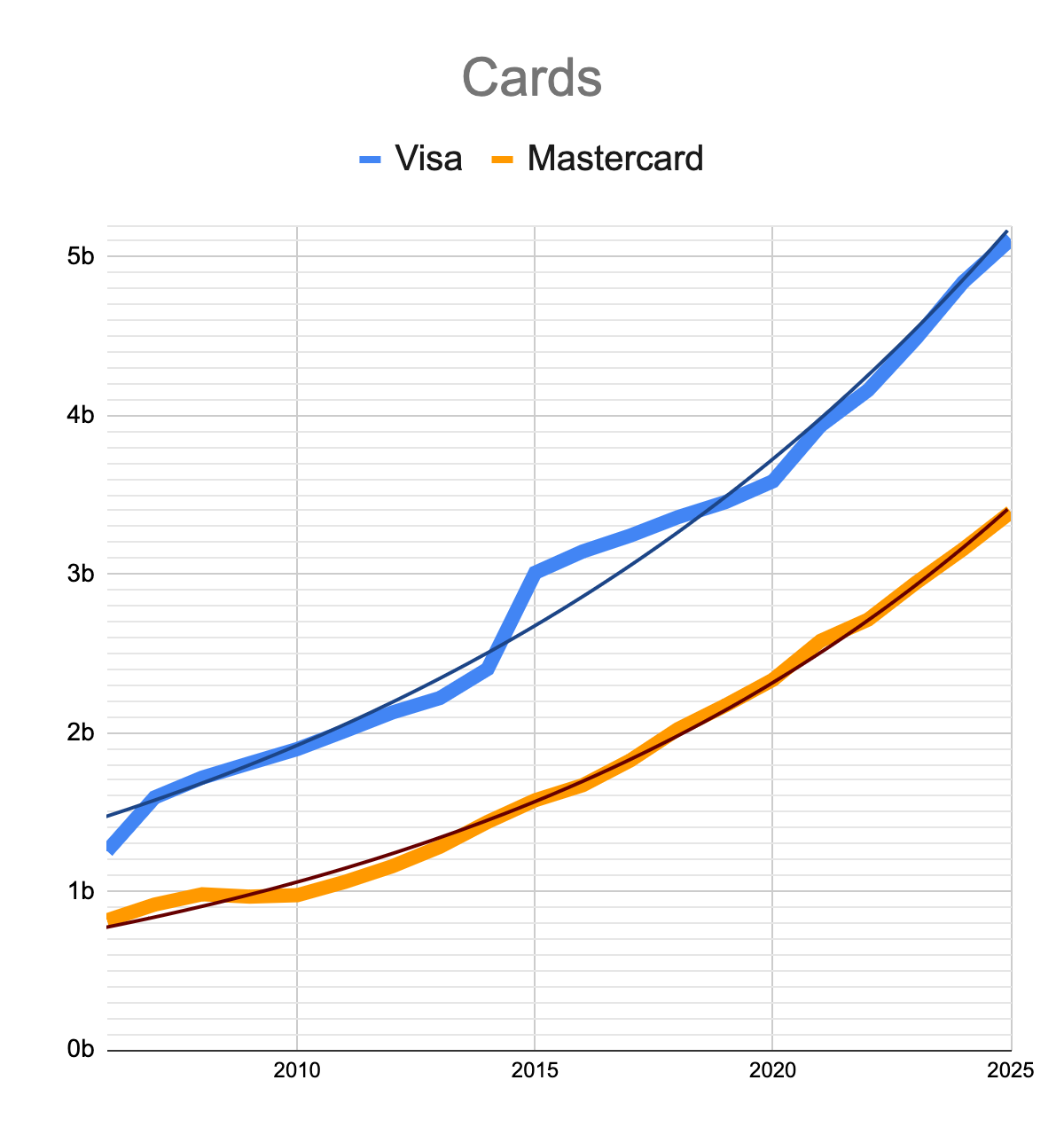
The two networks are growing in size in all aspects.
1. Transactions
2. Cards
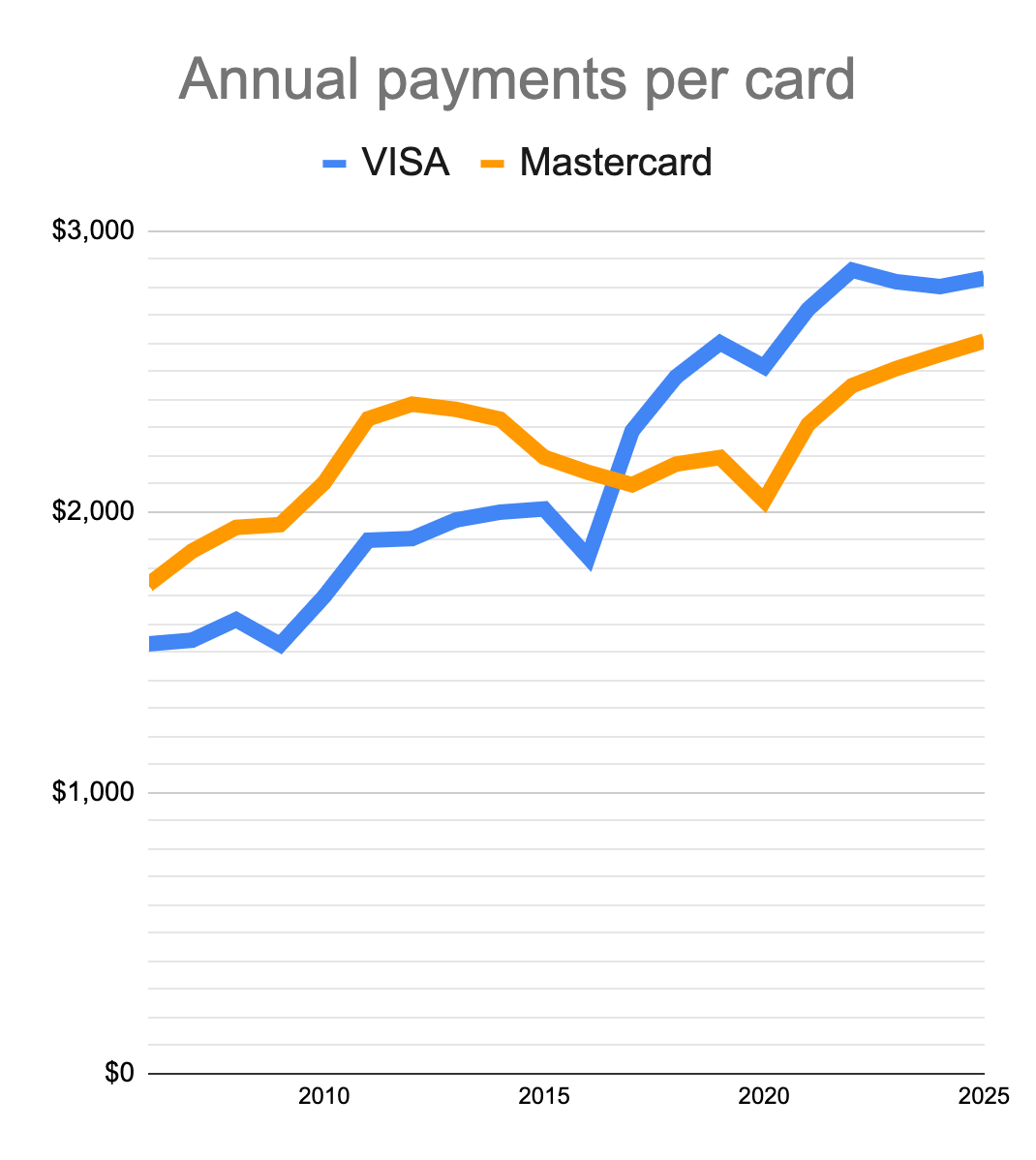
3. Volume per card
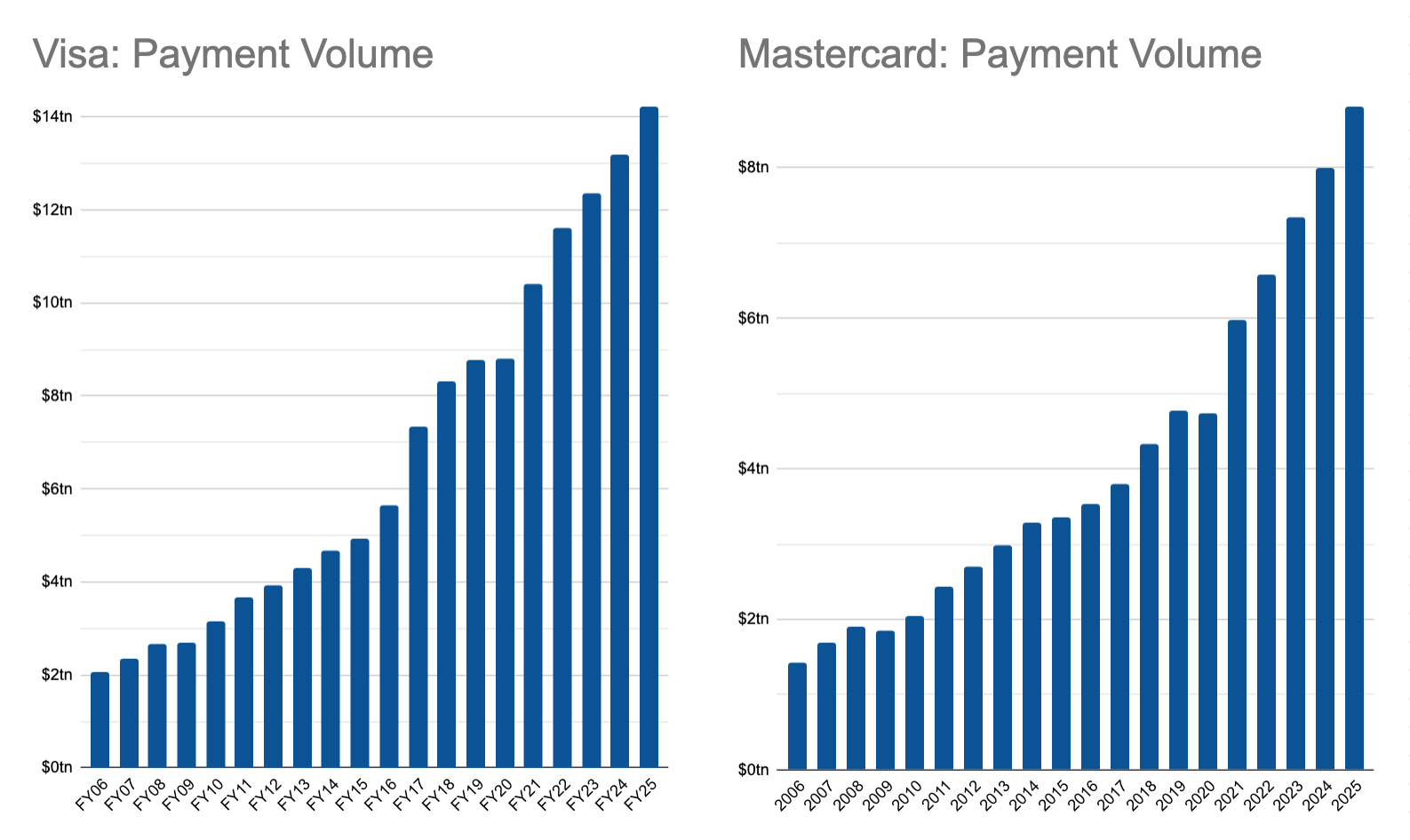
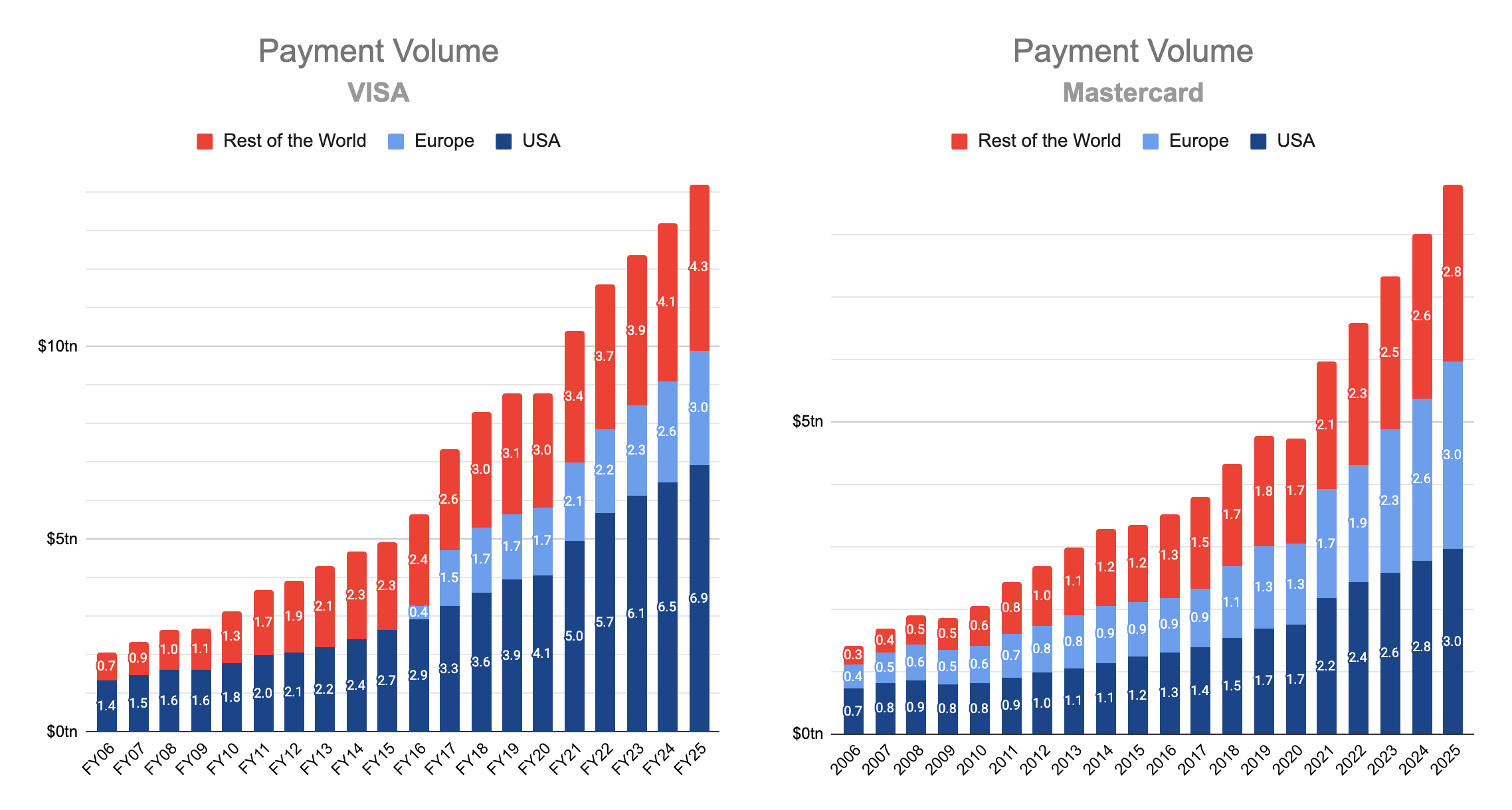
4. Volume
Exclusivity is strengthening
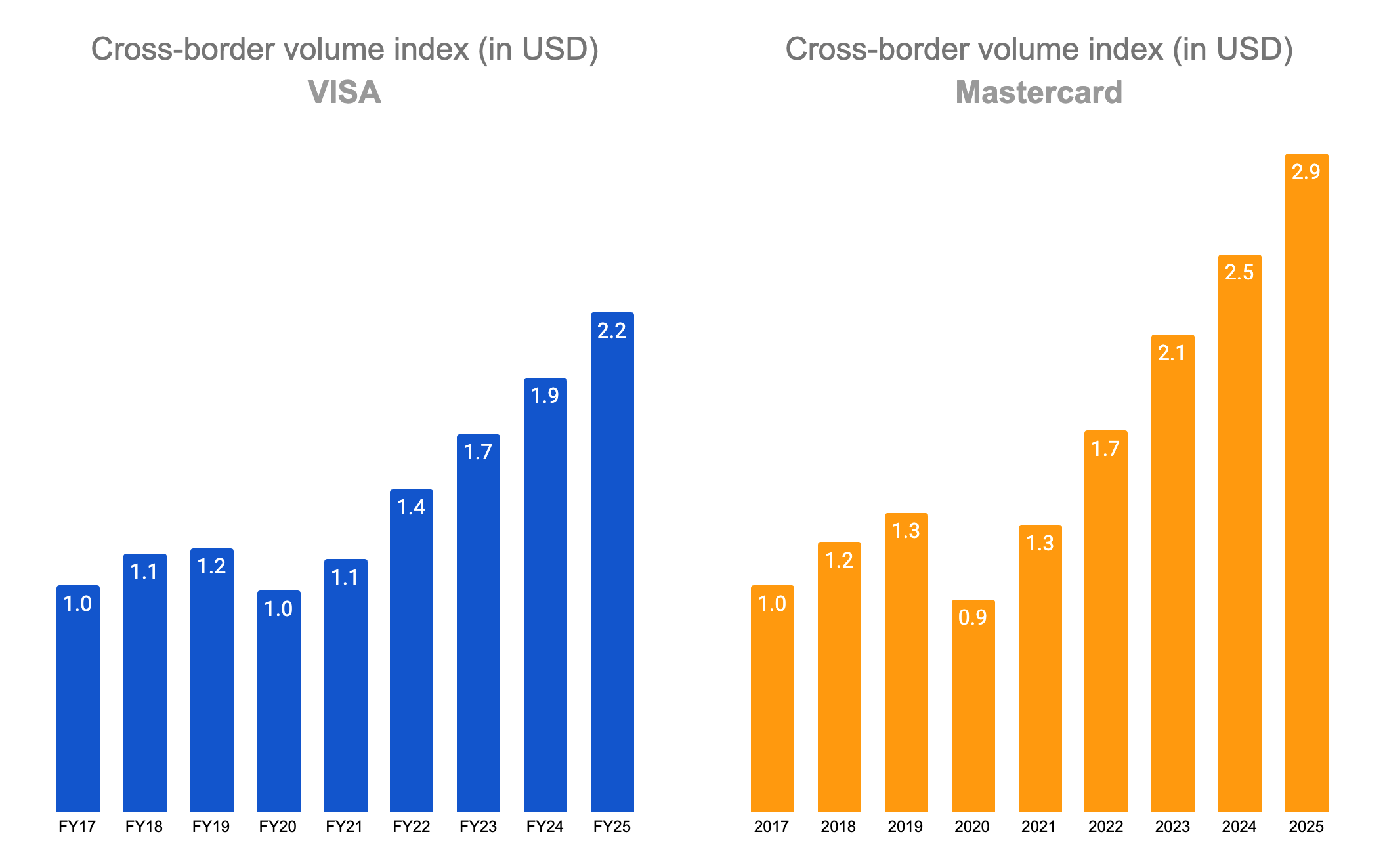
Visa and Mastercard are handling ever growing hard-to-contest payments on their networks.
1. Credit Payments
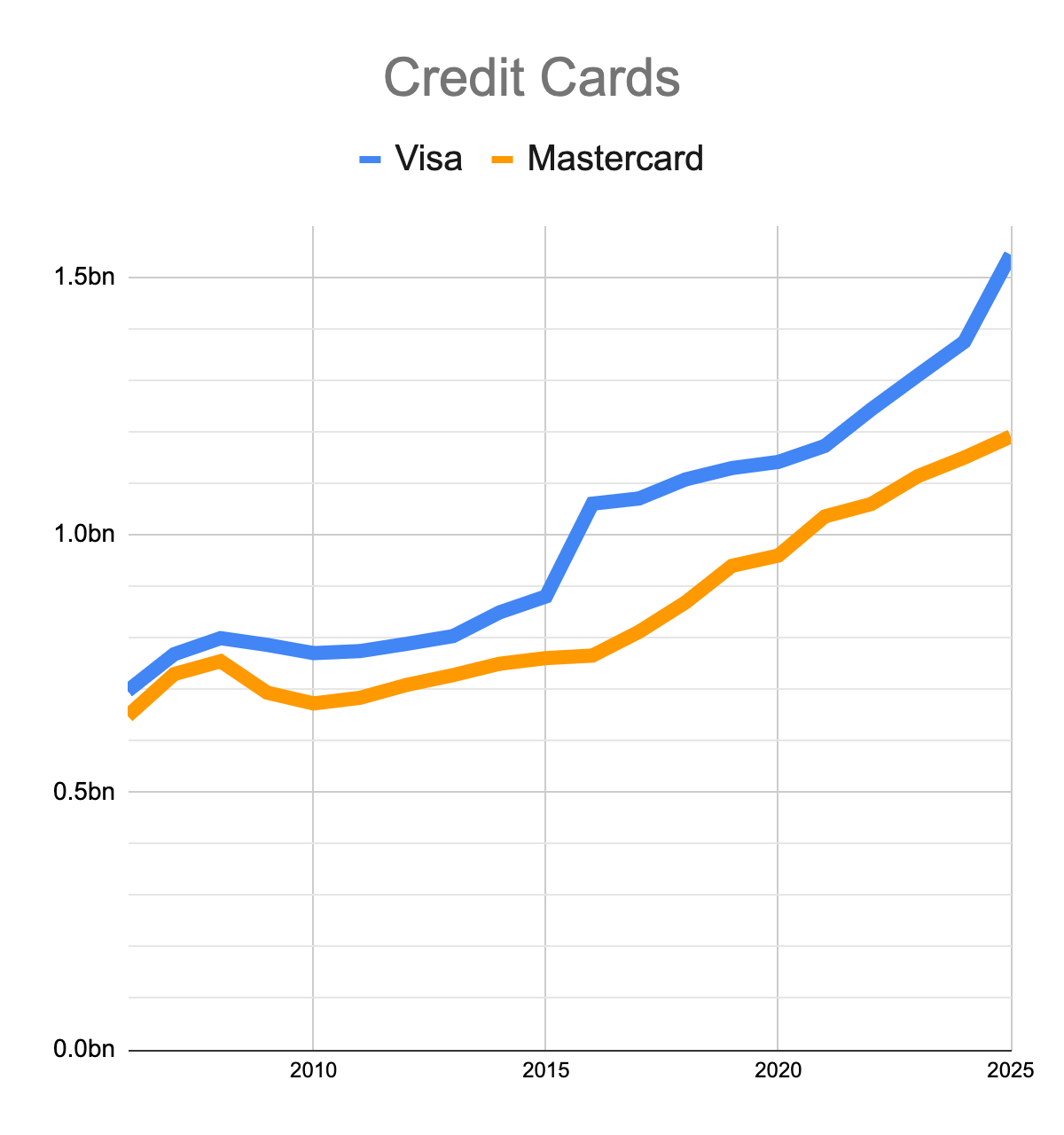
Credit Cards
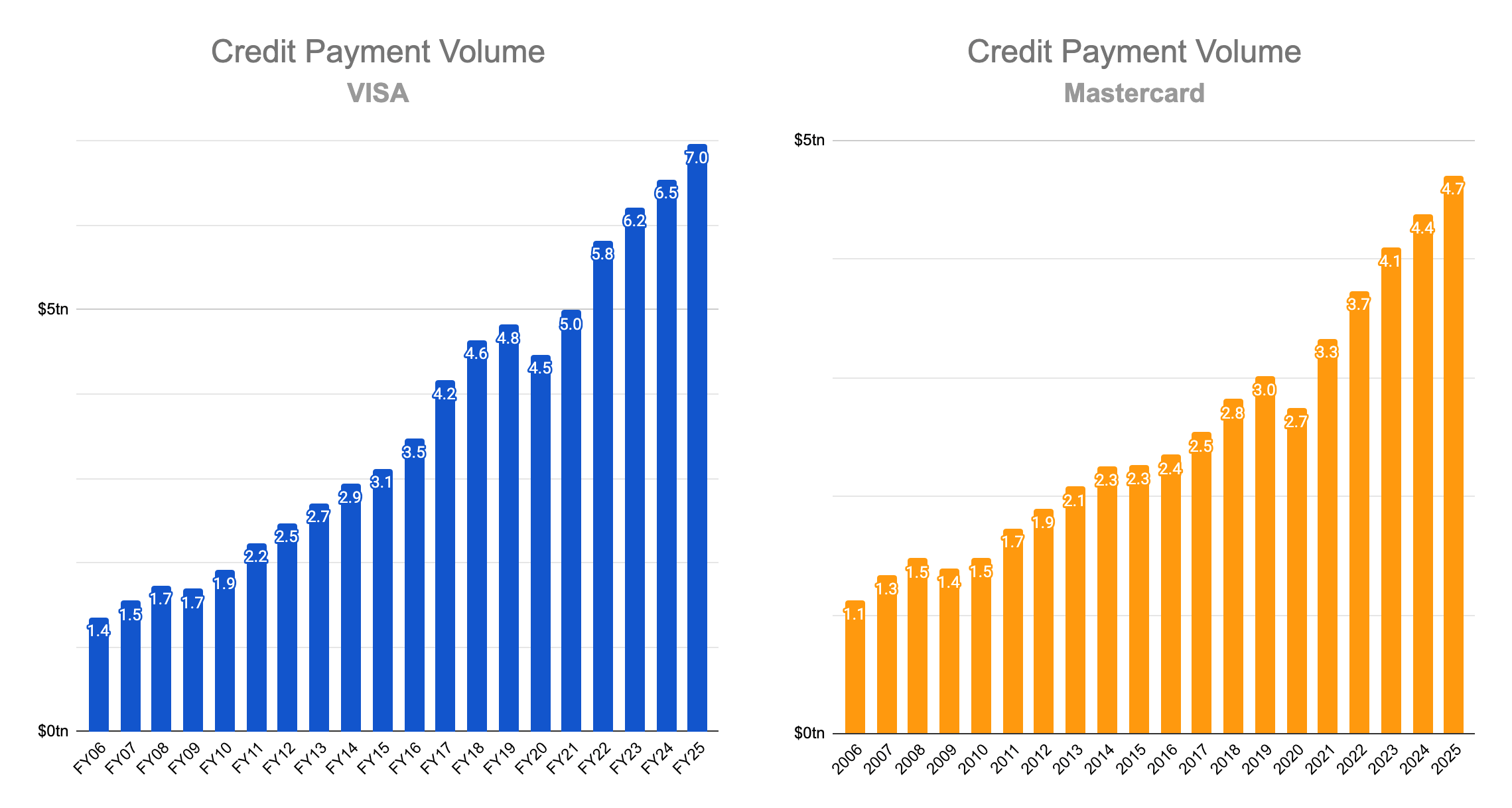
Credit Volume
2. Cross-border Payments
Higher Value Generation
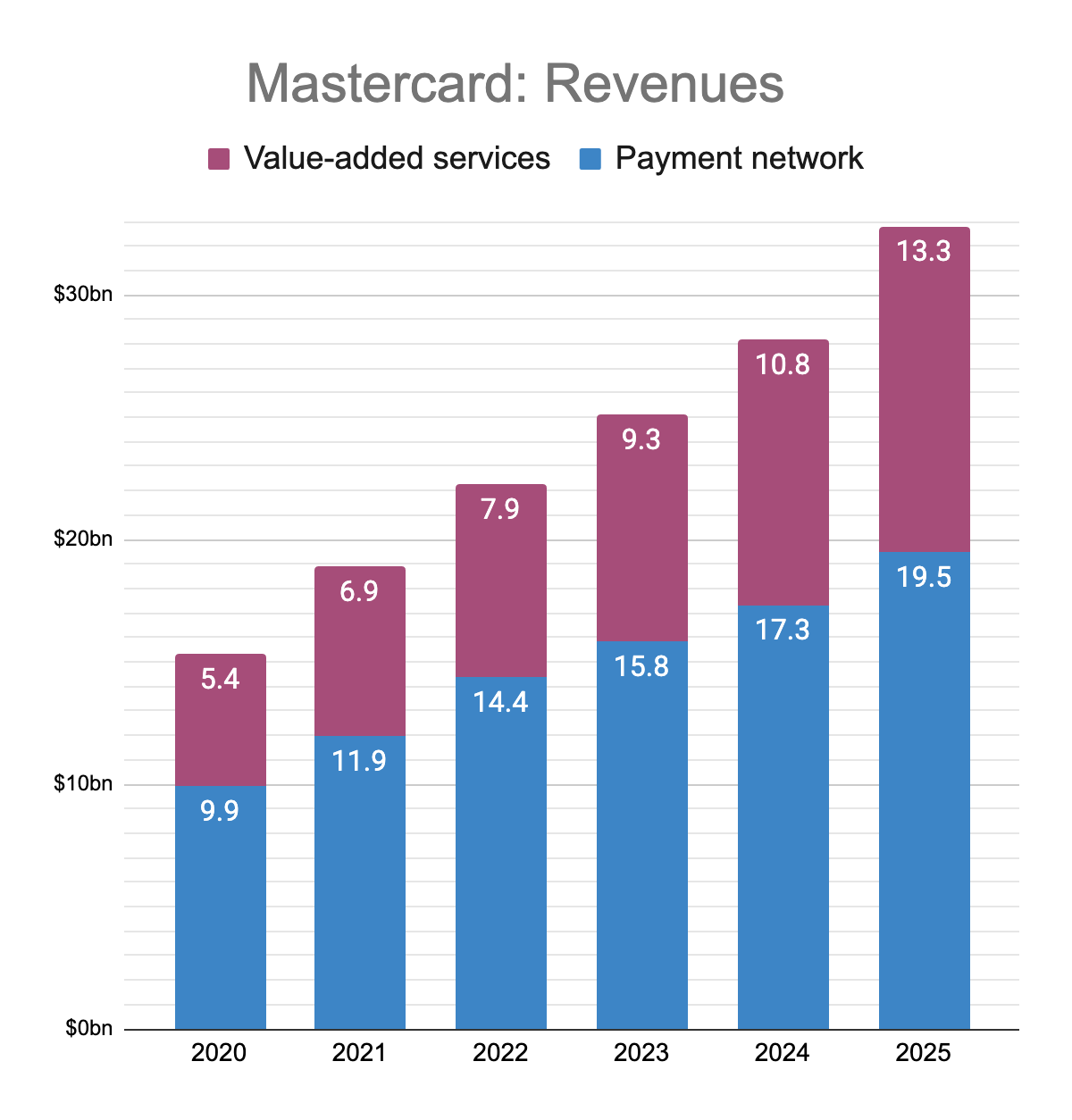
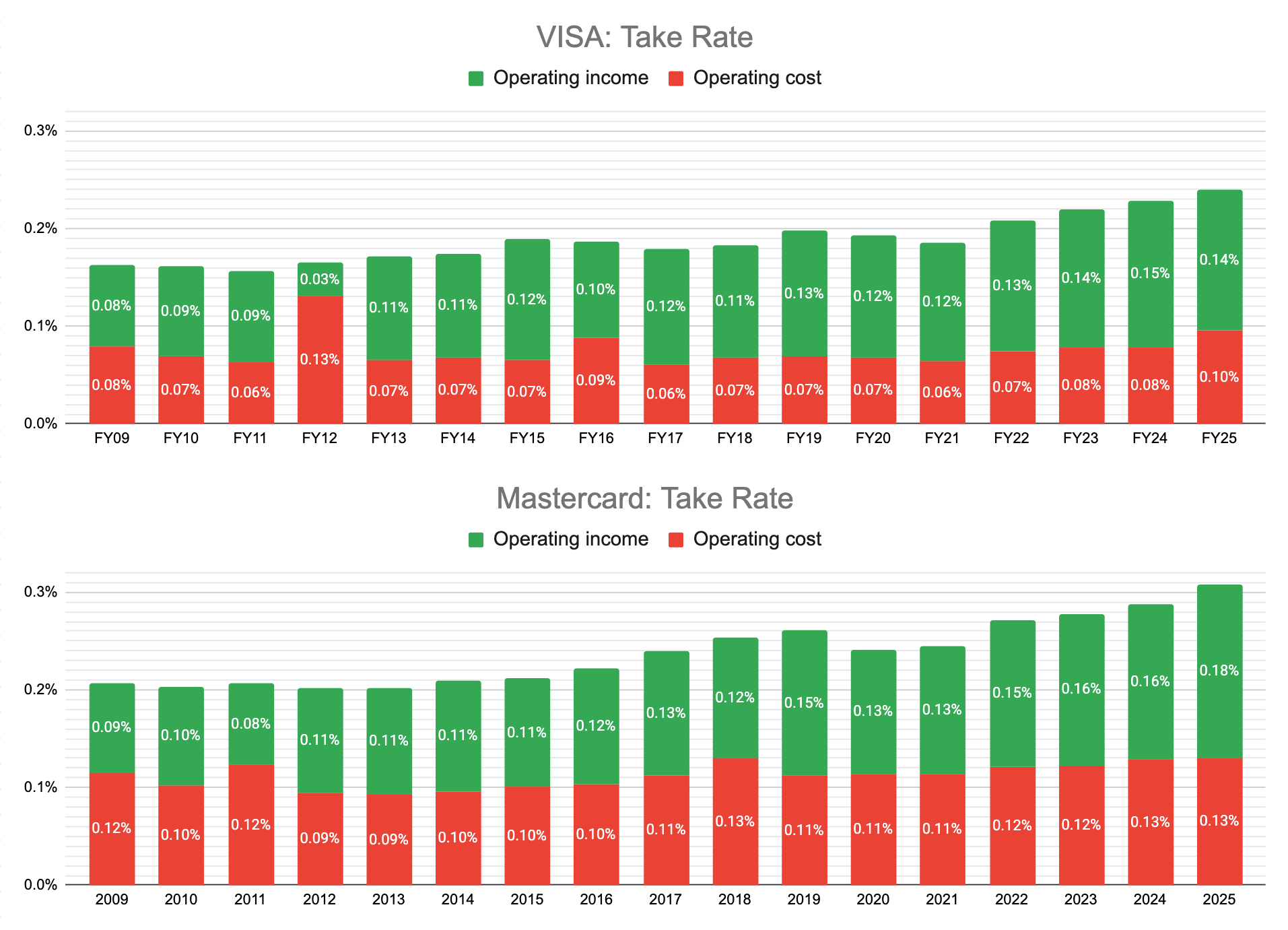
When you compare the companies’ revenues and profits against the total volume they handle, the rise in their yields is unmistakable.
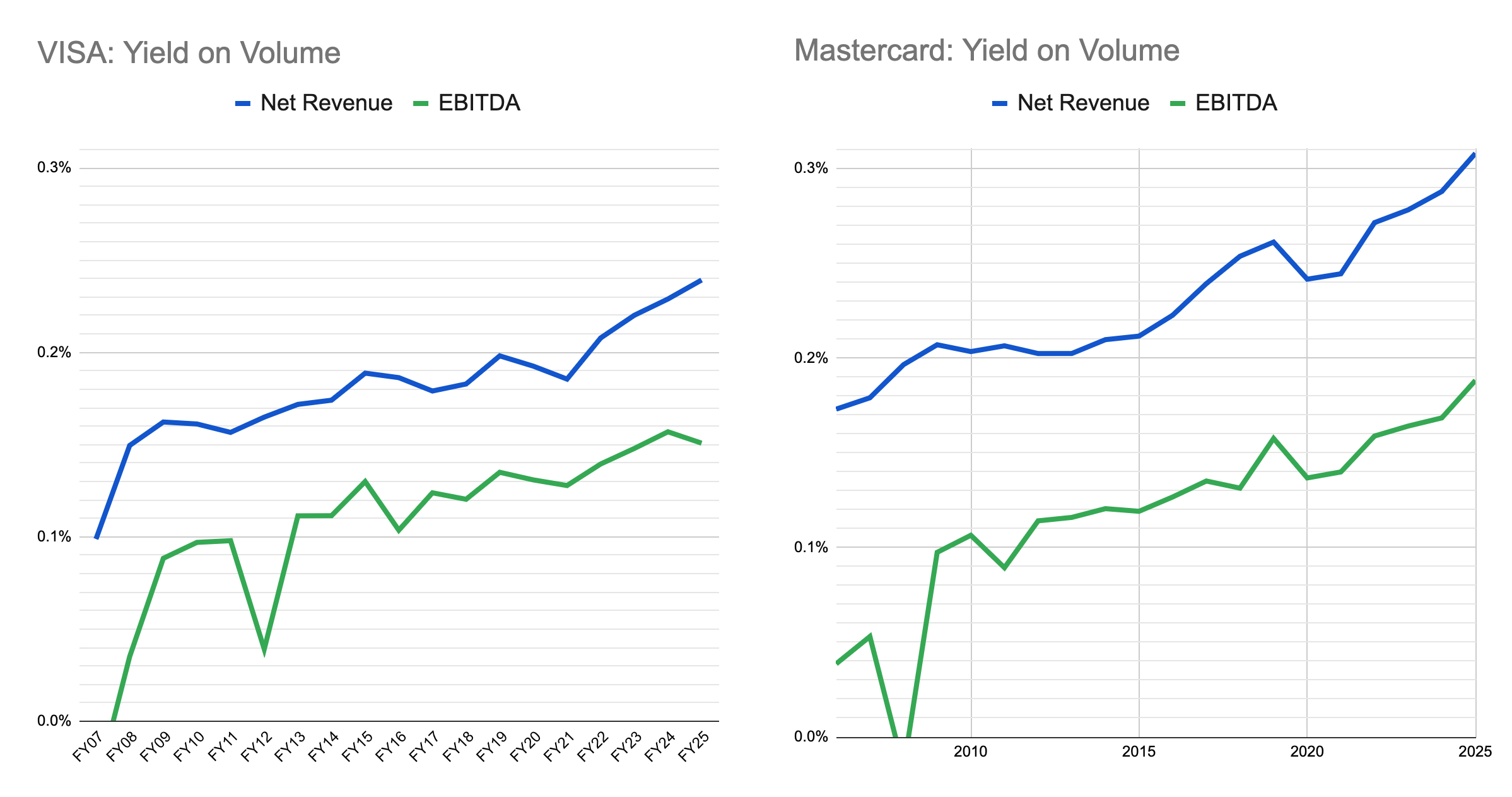
More interestingly, this rise has taken place while both networks’ fee rates were under pressure by partners and governments. The explanation seems to have two legs:
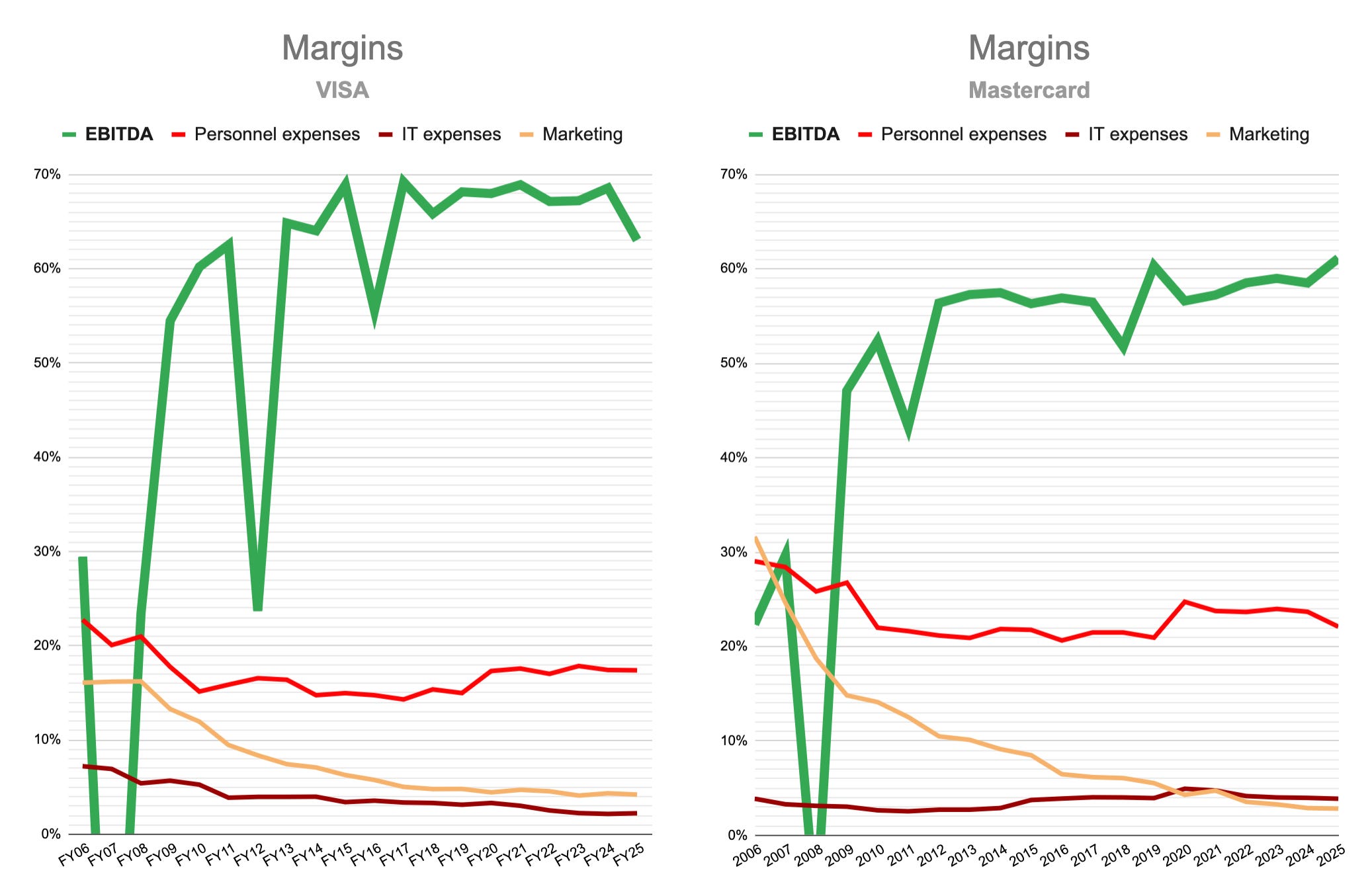
Operating leverage due to the growing network scale against fixed costs
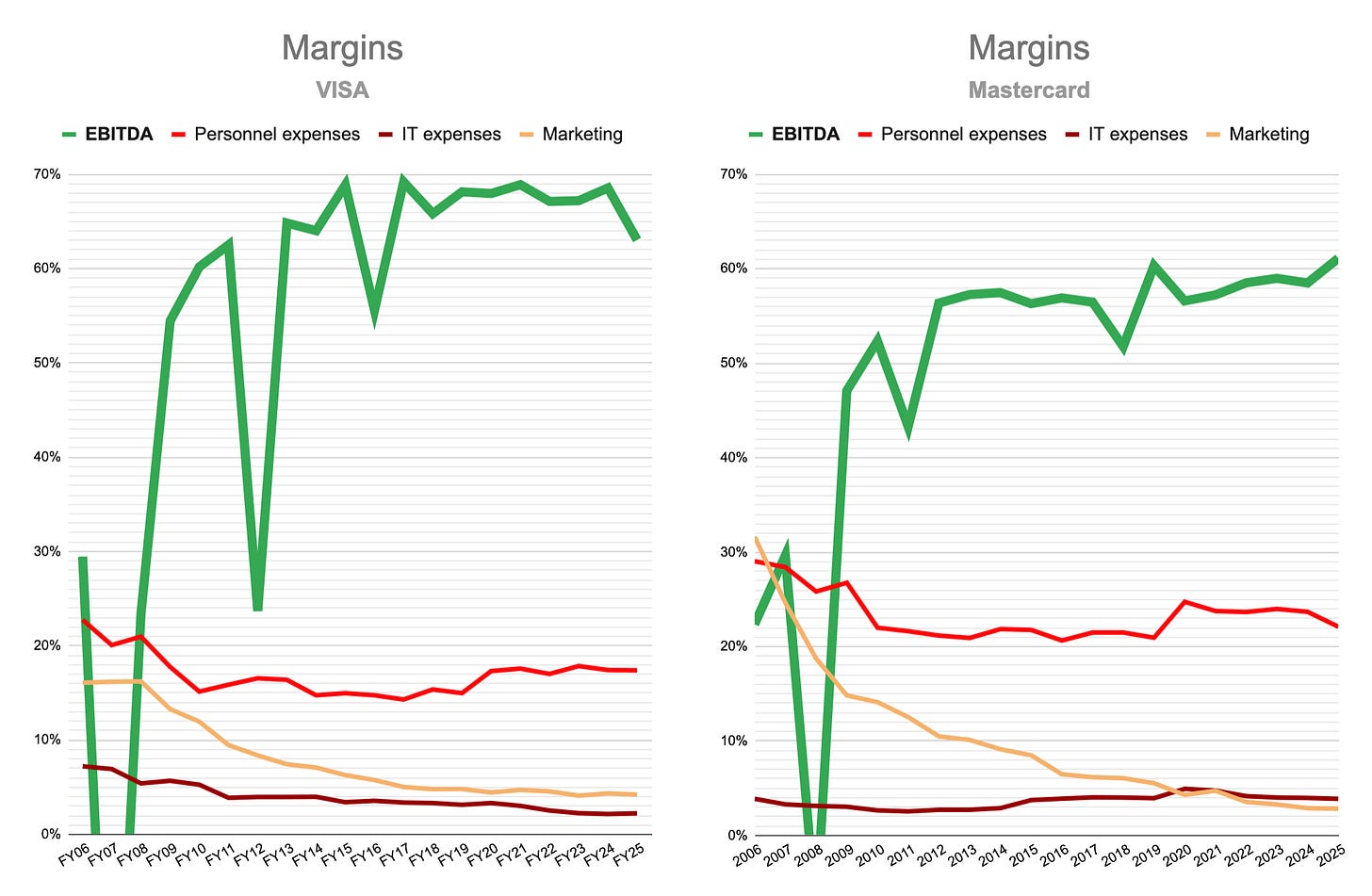
Introduction and growth of value-added services on top of payment networking

Risks
As highly visible and profitable networks that make up a critical infrastructure, Visa and Mastercard do not lack for downside risks.
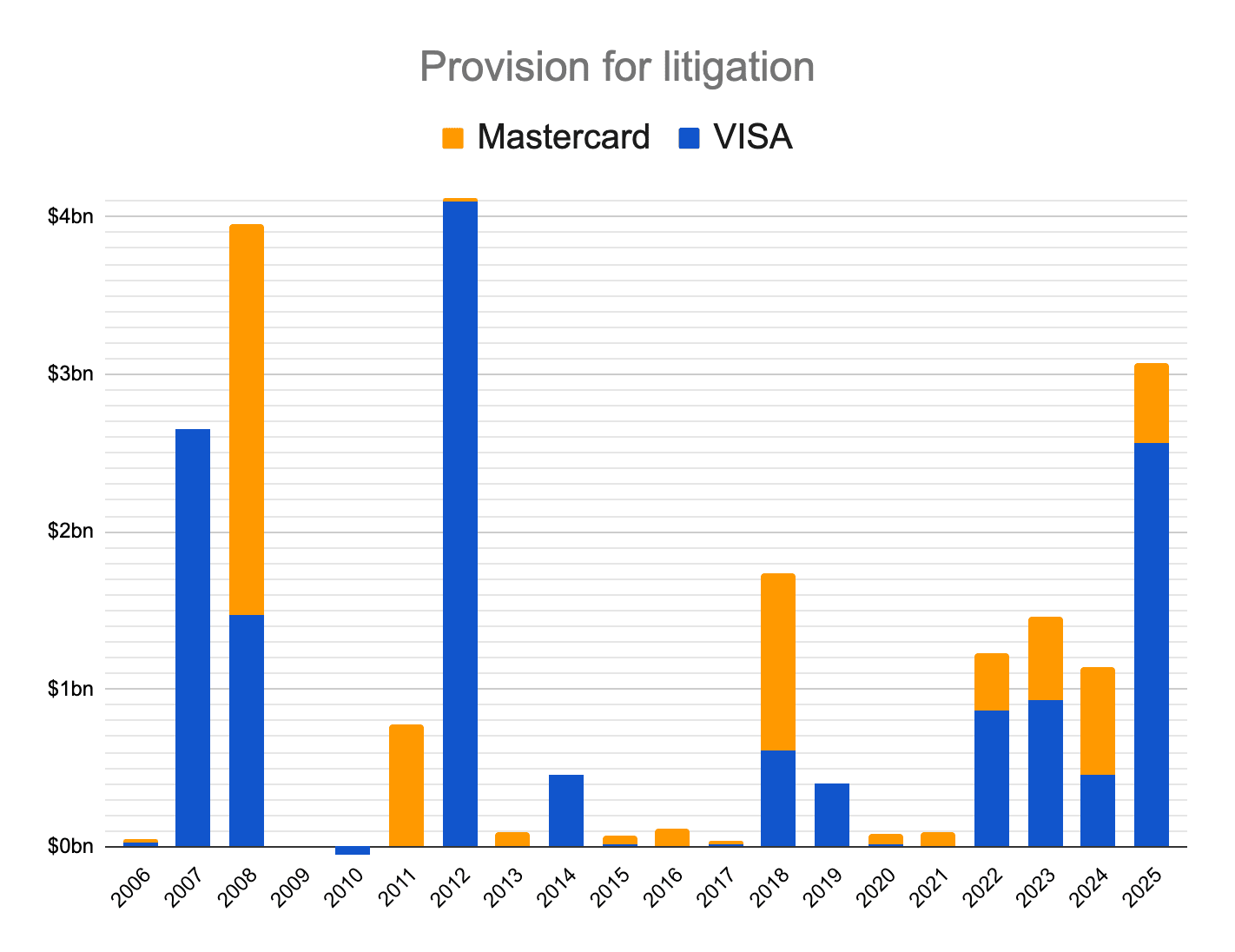
1. Legal
Especially in the US and Europe, both networks are routinely targeted in courts, so much so that litigation costs can be seen as just another cost of doing business.
2. Geopolitics
Developed Markets
In most developed markets where Visa and Mastercard’s networks are already entrenched, there continue to be commercial as well as state-led initiatives to develop alternative networks to lower fees and to bolster public sovereignty. In the US, Federal Reserve is developing a digital currency, FedNow, while the banking and retail led efforts have so far failed. In Europe, where a future decoupling from the US threatens to leave the field open for local champions, ECB plans the digital Euro and various European banks work on EPI.
Emerging Markets
Large emerging markets are arguably where the biggest damage to Visa & Mastercard’s potential has taken place. Leaving aside China, immense markets like India (UPI) and Brazil (Pix) have come up with their own state-led payment networks that dominate the domestic usage.
On the flip side, these same initiatives are also driving the cash-to-digital and mass banking transitions that may end up ultimately benefiting Visa and Mastercard as middle classes, consumer credit and cross-border travel grow in those markets.
3. Technology
Fintech ventures, stablecoins and AI agents could potentially pose disruption risks to the legacy networks. (Needless to say, I am not convinced that they are viable alternatives for various reasons, but I also can not claim an expertise in the topic as a generalist.)
4. Saturation
As an investment, both companies also face a slowdown risk in at least two different aspects:
Cash-to-card transition of the last few decades is bound to slow down in many markets simply because card payments already constitute a large chunk of the market.
Value-add sales can be thought of as a combination of alternative information offerings and consulting services and are by their nature a black box for the outside shareholder. It is hard to estimate — at least for me — if we are at the early stages of a new line of sustainable profits or the limits of overcharging.
Visa vs Mastercard
I treat both companies as a unified investment bucket because the two companies have slightly different strengths and owning both offers a simple diversification.
Visa: Higher Scale
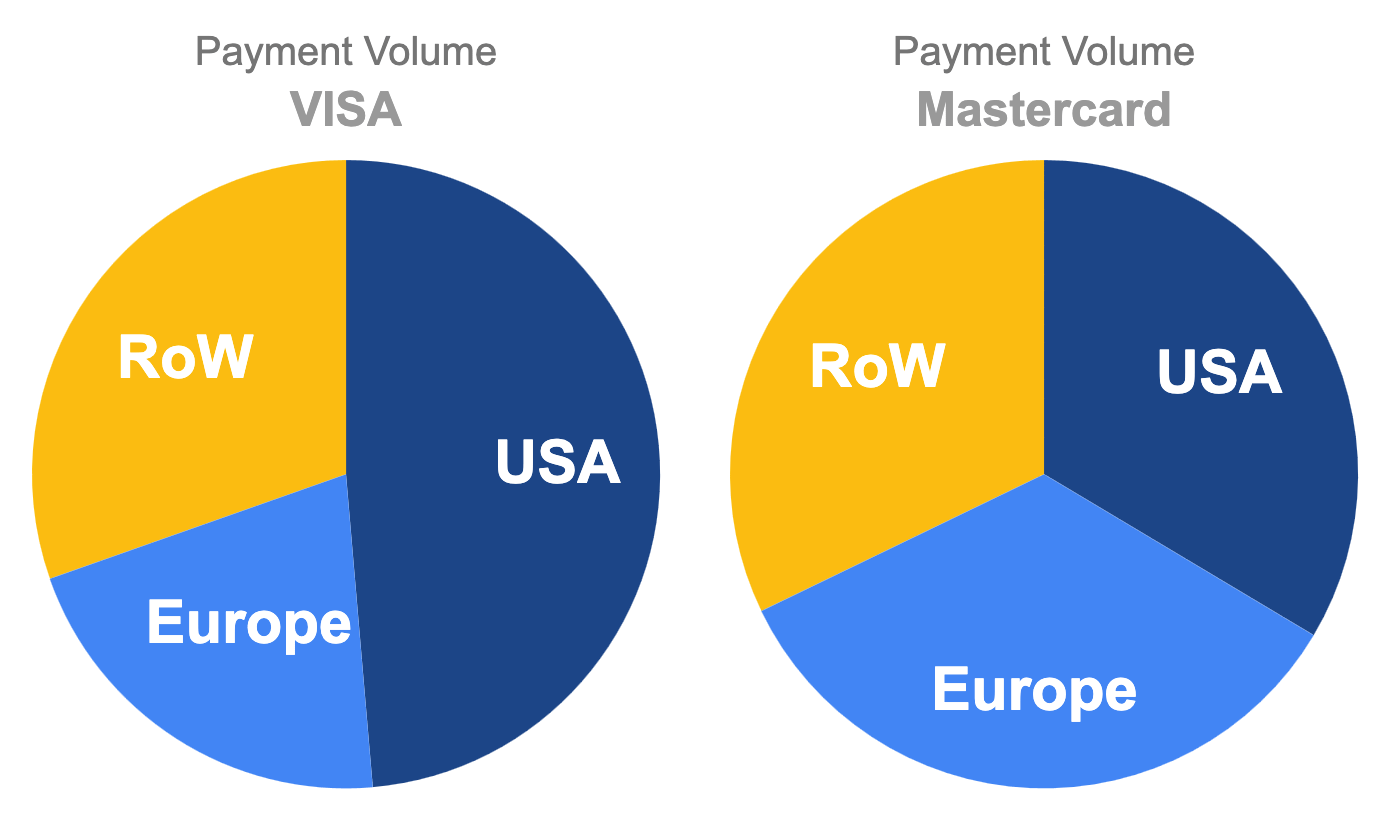
As can be seen in the volume data, Visa operates at a higher scale and with a higher exposure to the US, the greatest consumer market in the world.
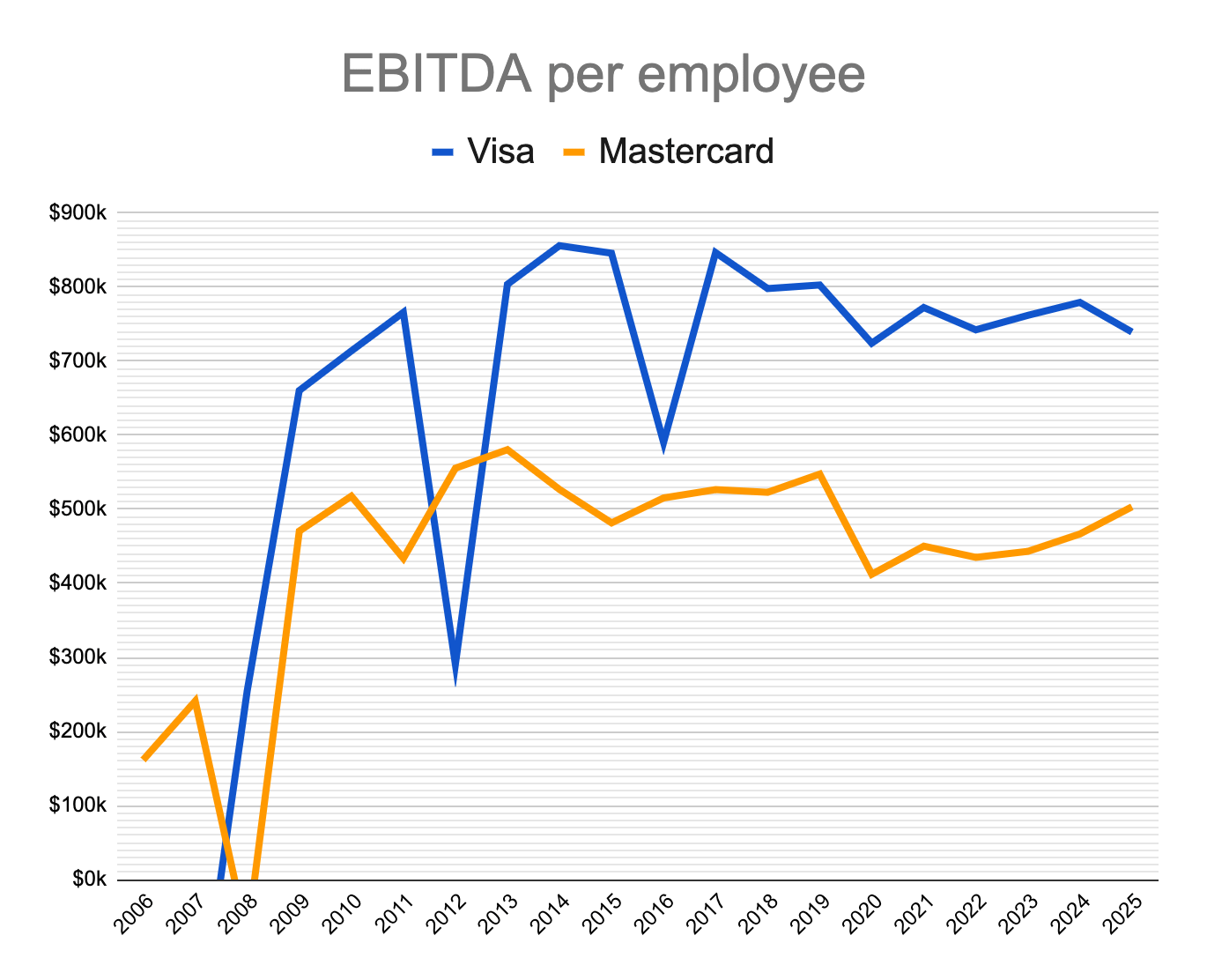
Thanks to its scale advantage, Visa runs its network at lower cost margins.
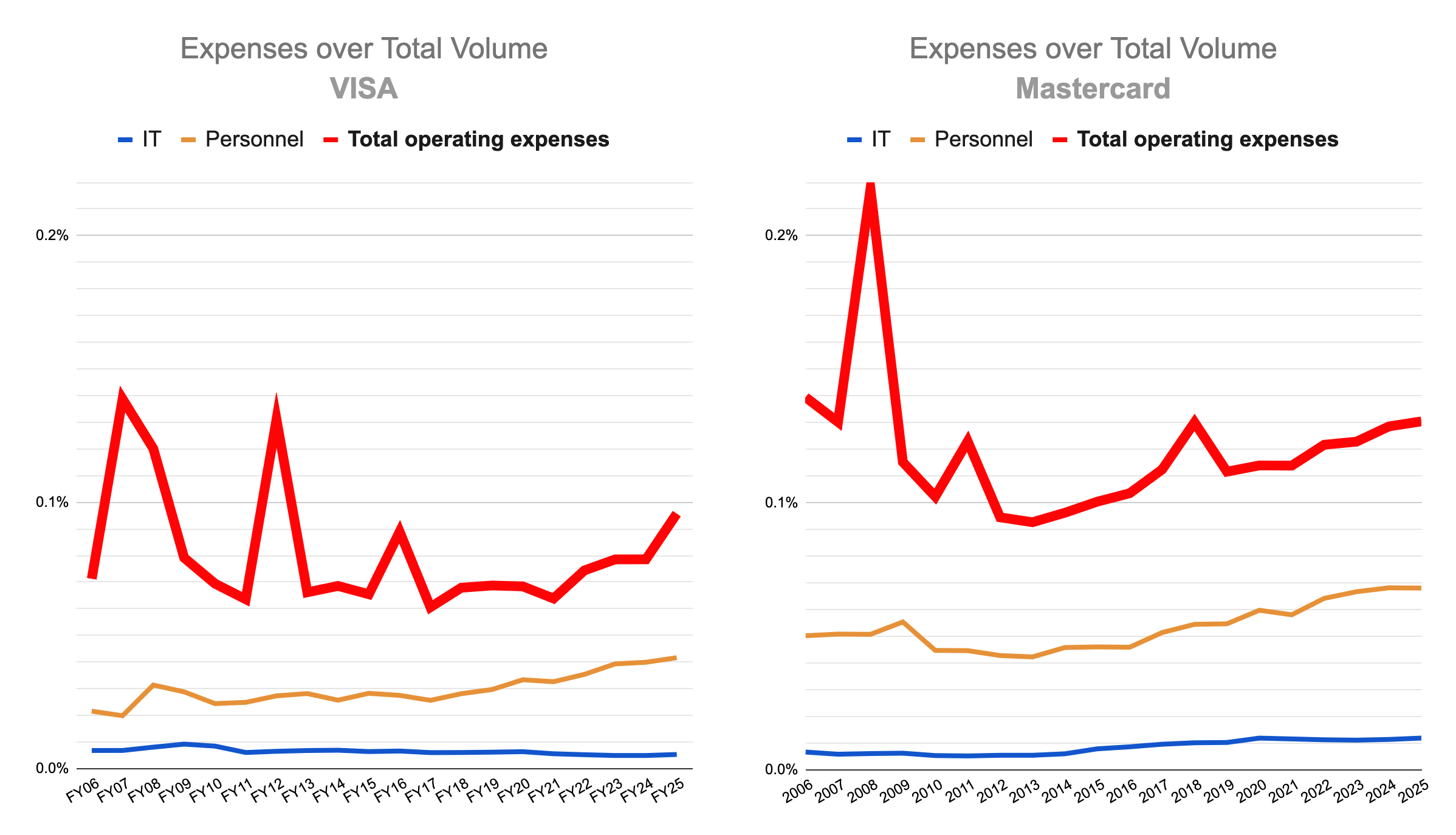
Thus, Visa processes each payment dollar at a much lower cost basis.
Visa earns 50% more EBITDA per employee than Mastercard.
Mastercard: Wider Upside
On the other hand, Mastercard has a higher exposure to the markets outside the USA, where cash-to-card and debit-to-credit transformations are generally at earlier development phases with more potential room for growth.
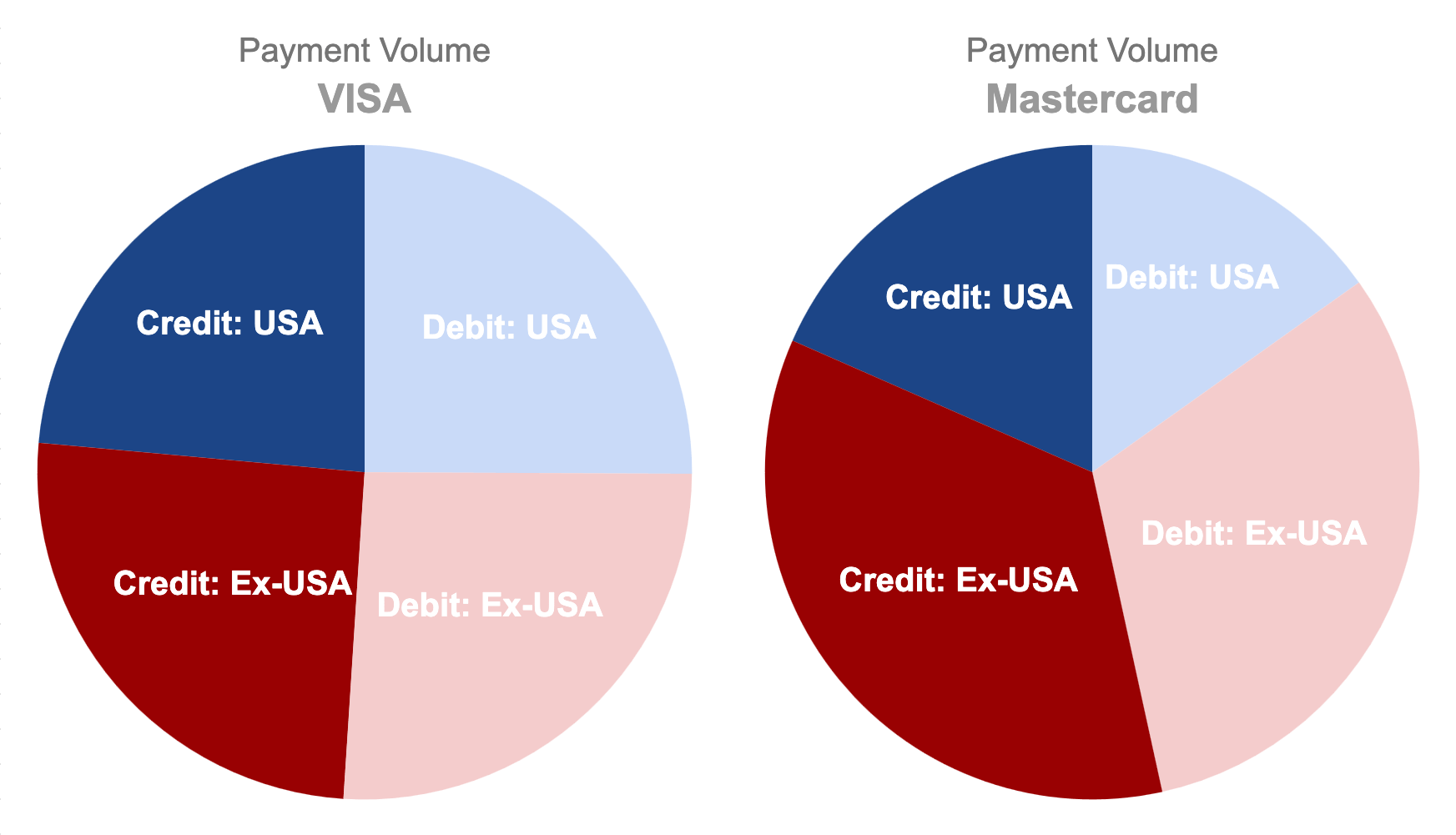
Mastercard’s ex-US exposure also comes with a higher weighting of credit card payments that could offer a stronger moat and pricing power.
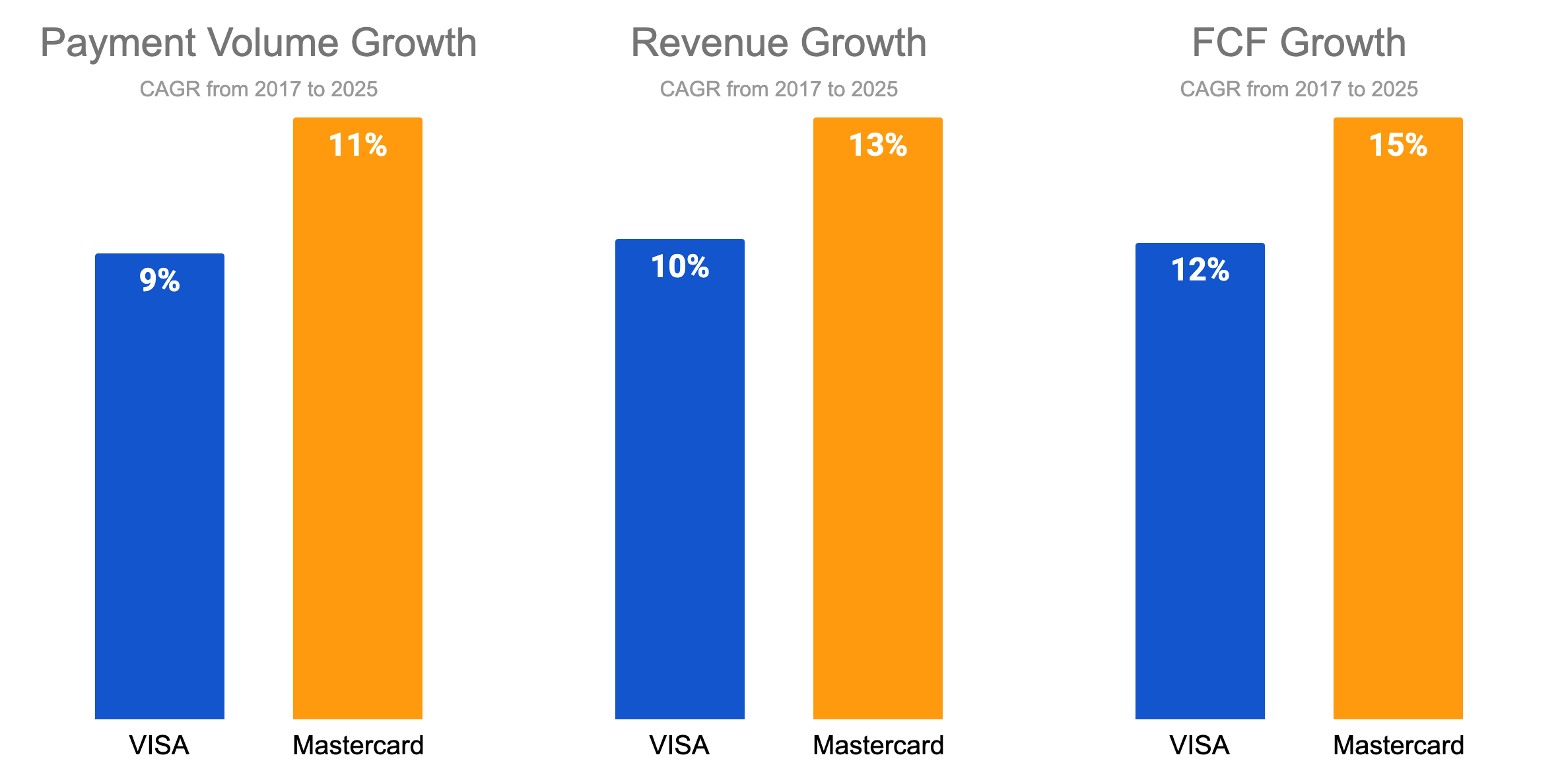
As a result, Mastercard has grown at a faster rate.
Cash Machines
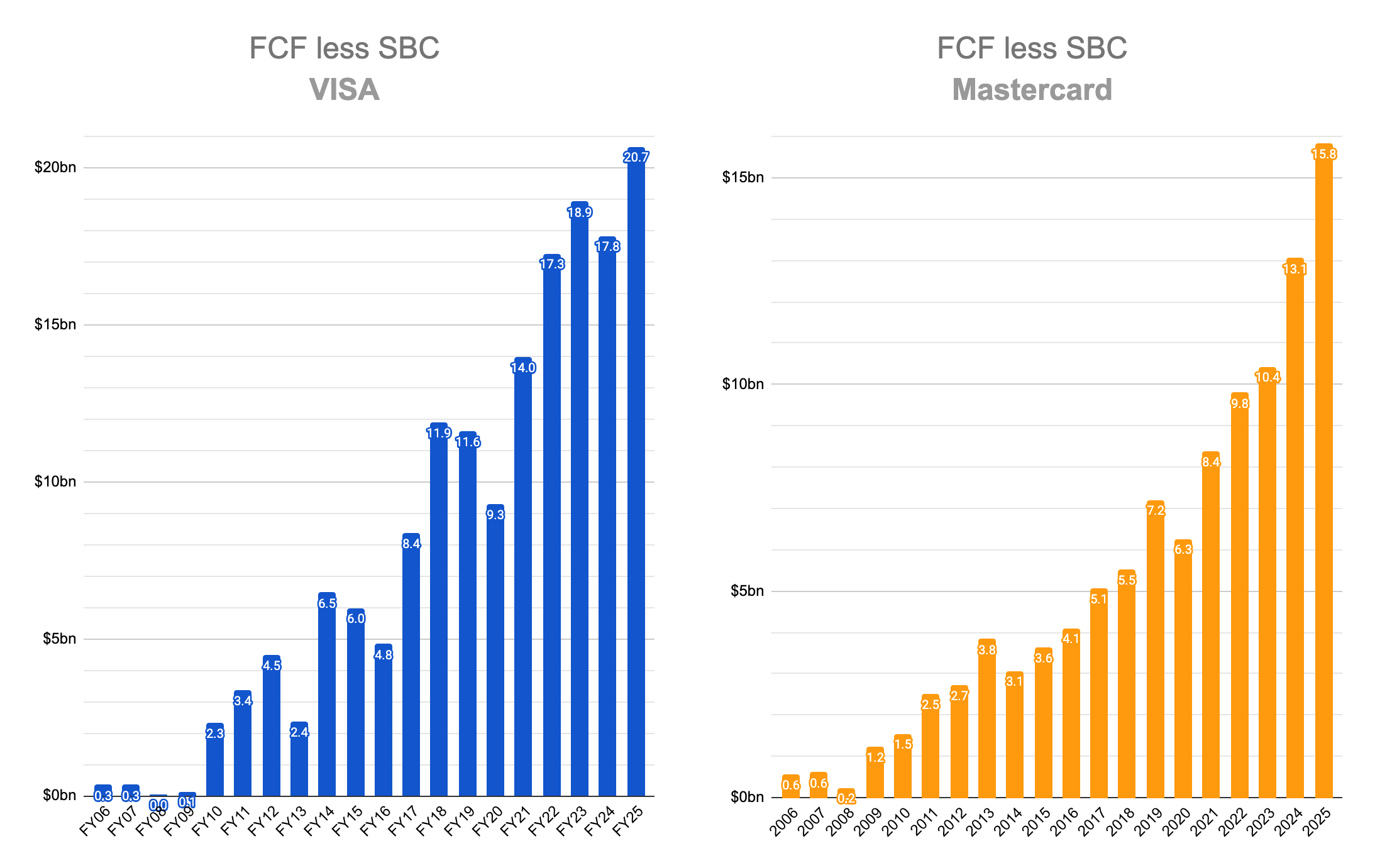
Both companies have been generators of growing cash flows.
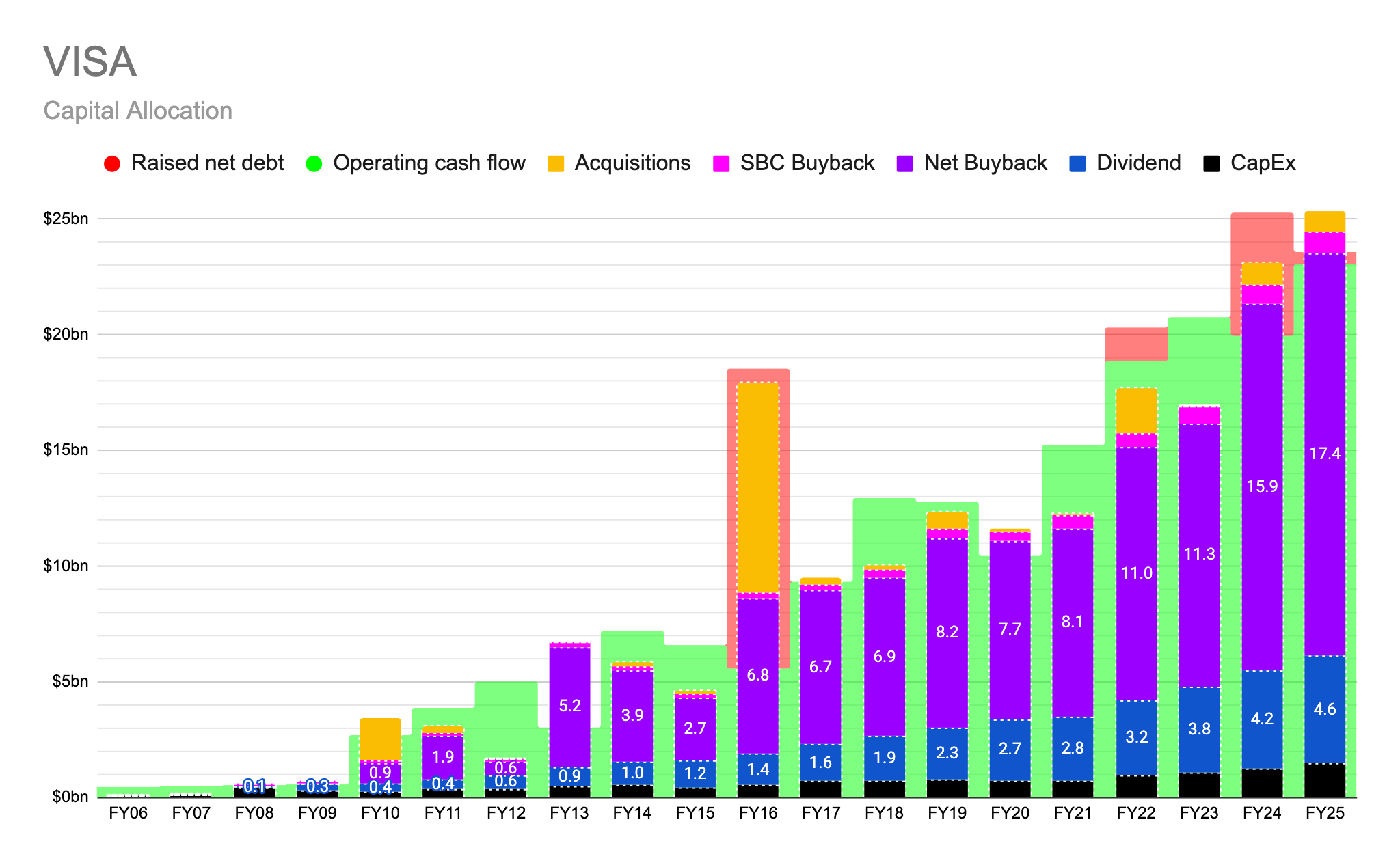
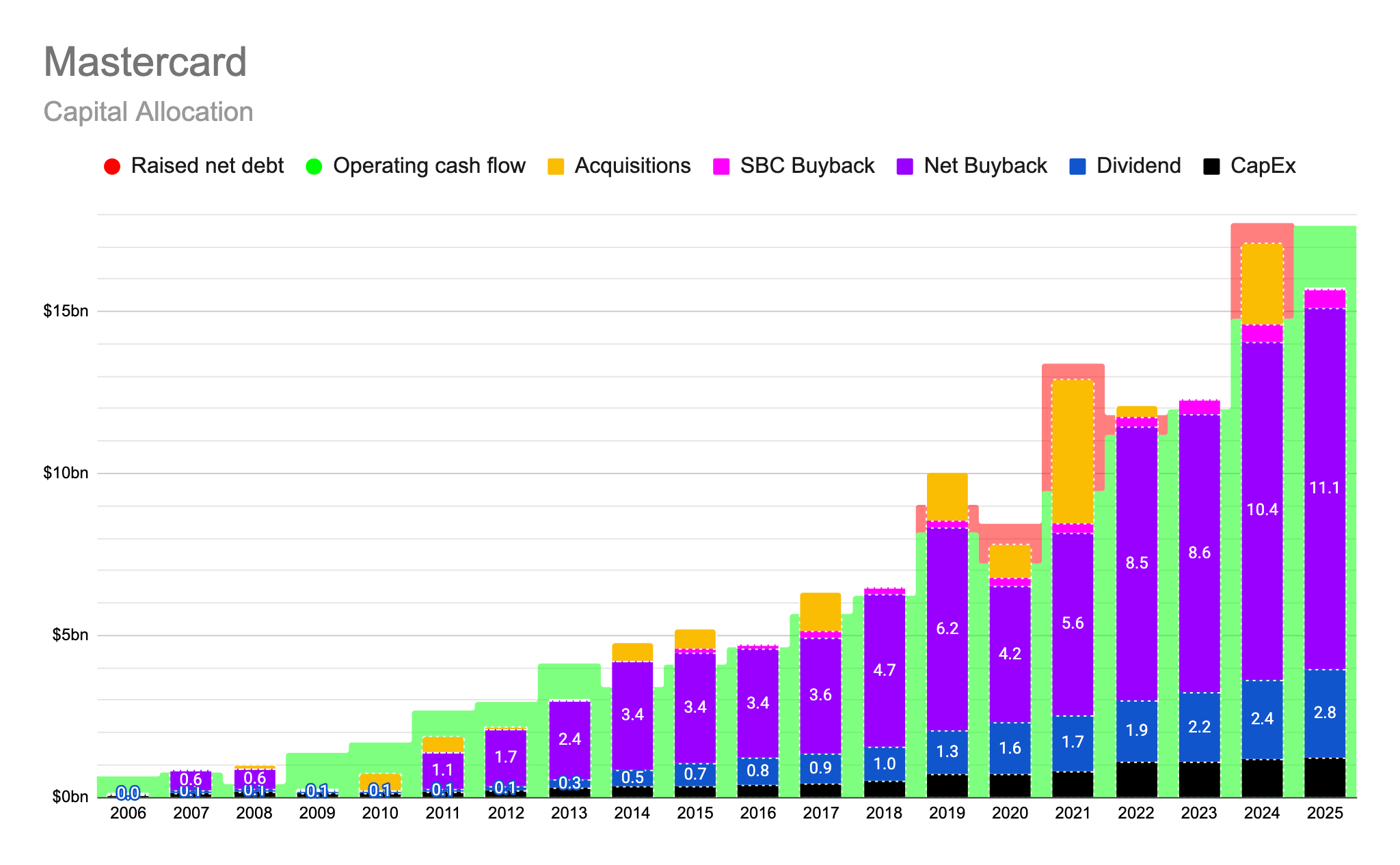
Aside from acquisitions, both companies have largely rewarded shareholders by distributing those cash flows, roughly with 20% in dividends and 80% in net buybacks.
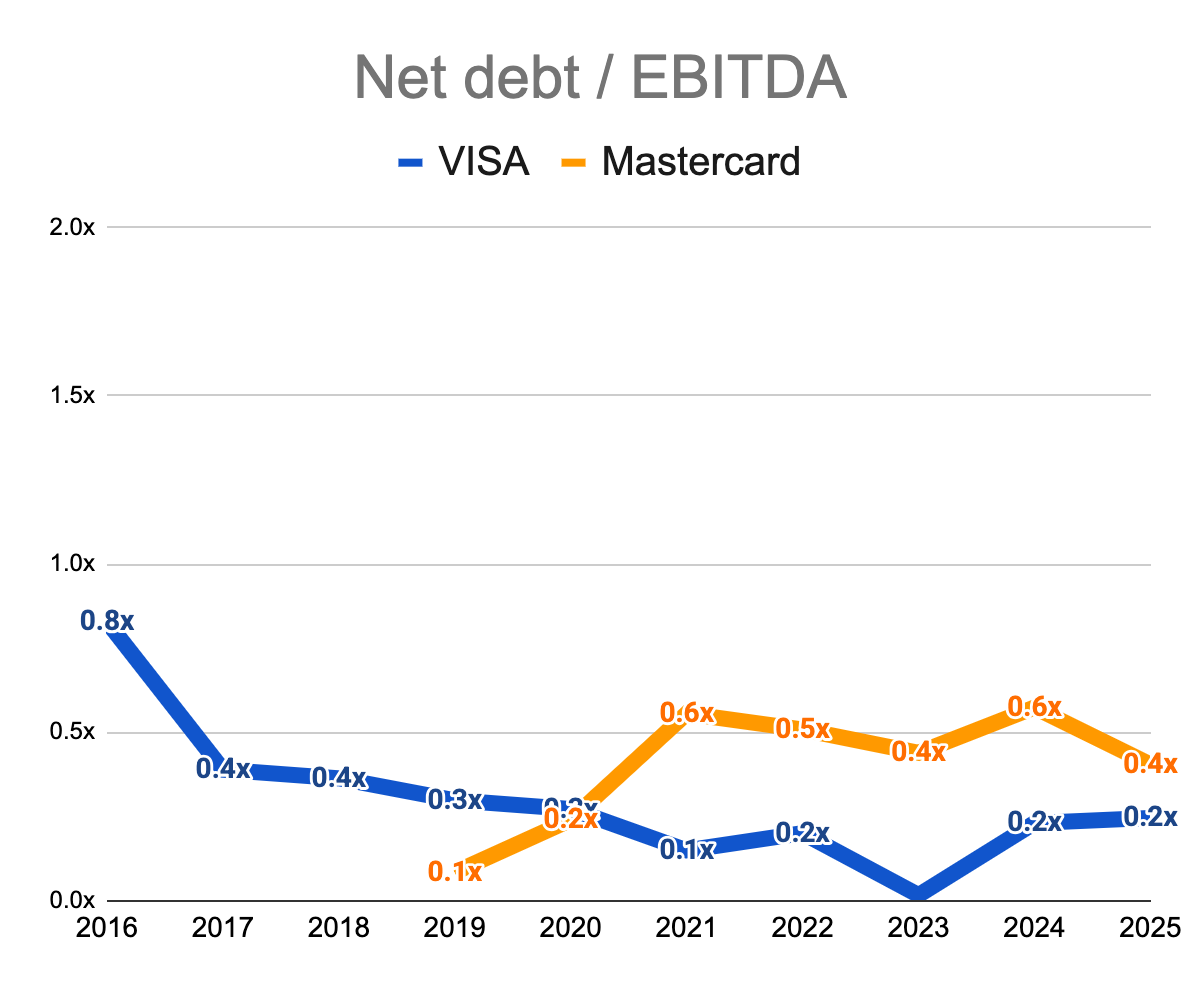
Both companies are run at very low debt levels.
The organic profit growth in addition to the decreased share count have so far resulted in very admirable long-term per-share track records.
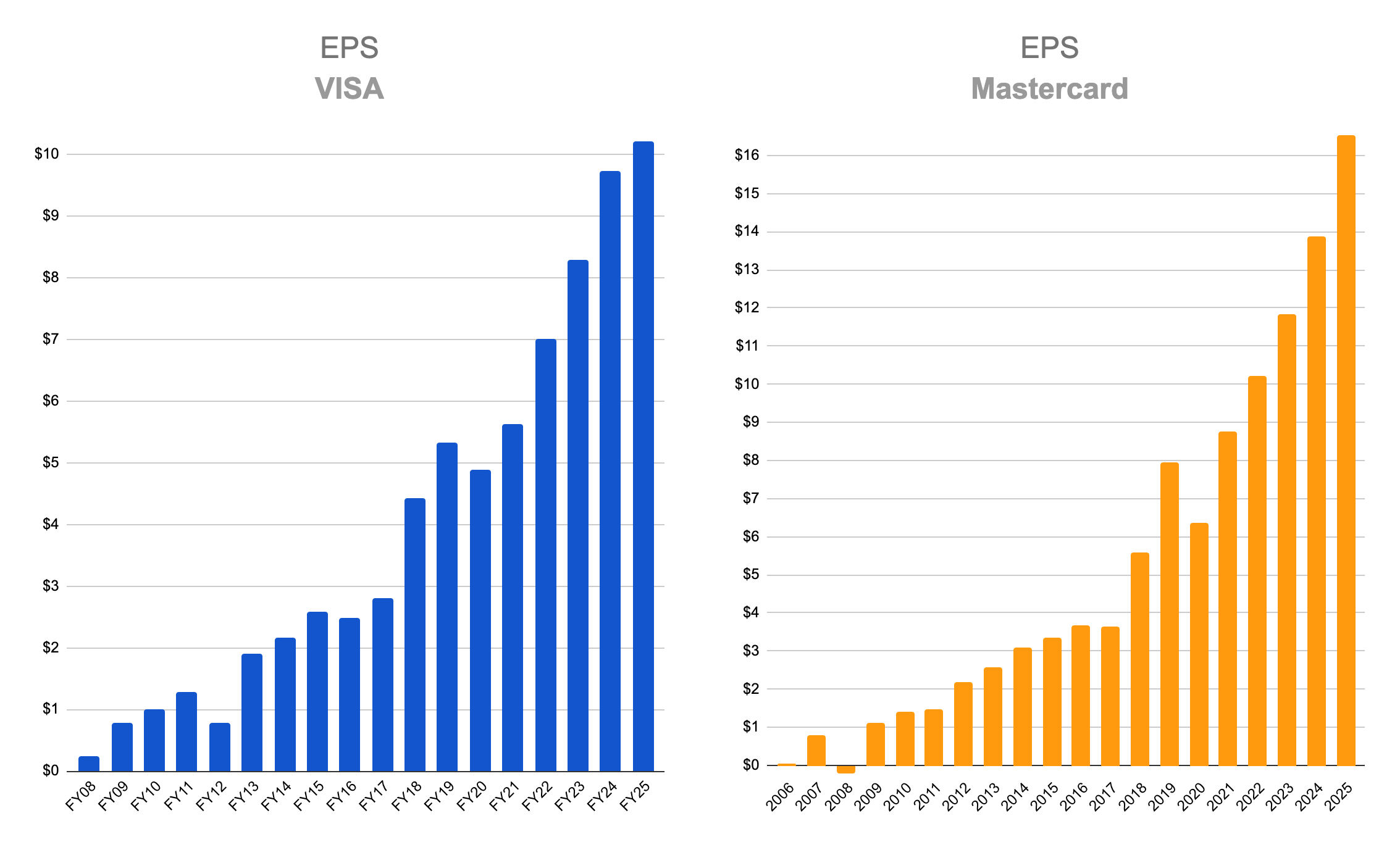
The question remains: Will the next 20 years rhyme with the last?
Disclaimer: This is not investment advice. Please read the full disclaimer in the About page.
Another risk from emerging markets like India is the Buy Now pay later playbook run by companies like Bajaj Finance which give 0% interest loans on applicances and electronics which are big ticket items. This essentially replaces a lot of credit card revenues for VIsa and MAstercard
Hello Ali !
Nice to read that.
Just a question : Why you are not invested at the same time in Adyen ?